Lab support
Getting started
What is planned for initial assays
- A provisional framework for crop-protection assays. Equipment, species, crops, and operating conditions require validation before experiments begin.
- A crop or leaf holder suited to the selected insect and crop
- A defined landing zone with a separate, inaccessible treatment holder for non-contact assays
- Camera and environmental recording specifications to be agreed during pilot design
- A candidate compound panel and matched controls, selected for the insect, crop, and exposure route. Compound supply and a positive control have not yet been established.
- A draft metadata template for linking each recording to its crop, insect, treatment, controls, and result provenance
- Crop-specific protocols, training footage, and data submission arrangements remain to be developed and reviewed.
What you will need to provide
- Reliable access to the target insect species, with its strain or collection source, life stage, sex, and rearing history recorded. Species and population choices must be agreed before comparing results across labs.
- A behavioral testing room with measured temperature, relative humidity, light cycle, and airflow suitable for the chosen insect and crop.
- A documented ventilation arrangement that supports the assay design and the lab’s chemical handling requirements.
- Insect holding/rearing cages
- Healthy crop plants or leaves of a recorded cultivar and growth stage, with enough matched material for treatment and control runs. Crop preparation and replacement intervals remain protocol decisions.
- Insect containment mesh suited to the selected species
- Micropipettes (P20, P200, and P1000) and sterile pipette tips
- Glass vials or microcentrifuge tubes for solution preparation
- Timer
- A species-appropriate method for gentle insect transfer
- Thermometer and hygrometer
- A camera that resolves the selected insect and the full landing zone
- Camera placement reference
- Assay cages sized for the selected insect, crop, and camera view
- A solvent and matched control compatible with the crop and assay
Assay
Preparing the insect cages
- Choose an enclosed assay cage with a clear camera view of the crop or leaf landing zone. Cage size, mesh, and viewing panel must be checked for the selected species before the pilot protocol is fixed.
- Ensure that each cage is clean, dry, and free of residual odors or chemical contamination before use. Inspect the acrylic panel and mesh for damage and confirm that the cage is securely sealed.
- Label each cage with the assay identification number, treatment group, replicate number, date, and operator initials.
- Transfer a recorded number of healthy insects at a defined life stage using an appropriate handling method. Pilot work must establish group size and age criteria. Minimize handling and avoid injury.
- Record the acclimation period and environmental conditions. Establish an appropriate period for the selected insect and use it consistently within a comparison.
Preparing the crop landing surface
- Select matched crop plants or leaves and record crop, cultivar, growth stage, leaf age, and preparation method.
- Mount the crop material securely and define the visible landing zone before treatment. Keep presentation consistent across matched runs.
- Document crop condition and prior chemical exposure. Establish a cleaning or replacement procedure for reusable holders and use fresh crop material where required by the pilot design.
Arena layout (M Zero reference)
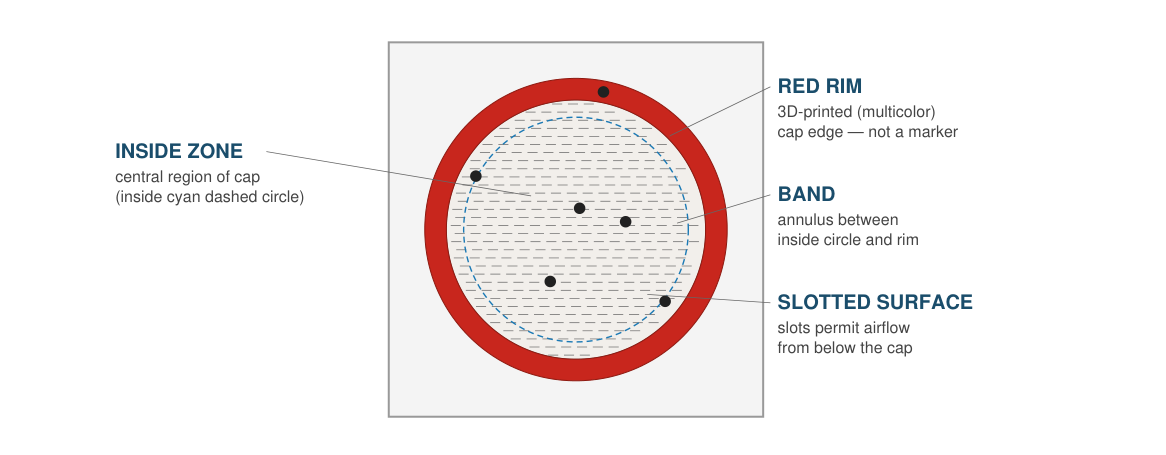
Assay configurations
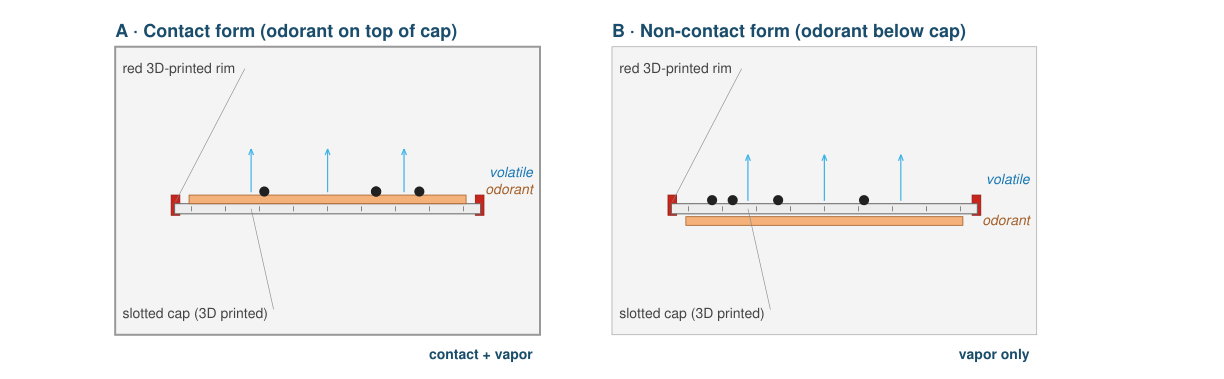
M Zero mosquito assay reference: (A) contact and (B) non-contact. These diagrams retain the original platform; crop-specific arena drawings and validation are pending.
Control assay procedures
- Define the target insect, crop, cultivar, and behavioral question before choosing controls. This sequence is a draft planning framework, not a validated crop protocol.
- Prepare matched crop material for each control and treatment. Record crop condition and keep its presentation consistent.
- Set the camera, landing zone, environmental conditions, and planned recording duration before introducing insects.
- Introduce insects using the agreed handling method and record their count, life stage, sex, and source. Keep these factors matched across treatment and control groups.
- Include matched contact and non-contact solvent controls when both configurations are tested. Establish replication, randomization, and control timing in the pilot design.
- For a non-contact control, place the control solvent in the inaccessible treatment holder at the planned volume.
- For a contact control, apply the control solvent to the defined crop landing surface using the same method and volume as the treatment.
- Use a consistent, recorded interval between application and recording. Check that the solvent and application method do not confound crop condition or behavior.
- Confirm the crop, treatment holder, insects, and camera are positioned as specified, then begin the matched recording.
- Record the complete planned observation period. Retain the raw video and document deviations, insect injury, and crop damage separately from landing behavior.
Contact and non-contact assay procedure
Non-contact assay
- Select a pilot dose and solvent appropriate to the compound, insect, crop, and exposure route. Record concentration, applied quantity, and units.
- Apply the compound to a separate holder near the crop landing zone. Prevent insect contact with the treated holder and record its position.
- Use the same application-to-recording interval as the matched control and document it in the metadata.
- This configuration is intended to measure behavior without contact with the treatment. Verify separation and record airflow before interpreting any effect as an airborne response.
- Position the crop and cage consistently with the matched control, then begin the recording.
- Record the planned observation period with the full landing zone visible. Link the video to its treatment, control, and protocol version.
Contact assay
- Select a pilot dose and solvent appropriate to the compound, insect, crop, and exposure route. Record concentration, applied quantity, and units.
- Apply the compound to the defined crop or leaf landing surface. Record the treated area and application method.
- Use the same application-to-recording interval as the matched control and document it in the metadata.
- Insects can land on and contact the treated crop surface. Record landing, contact, and departure separately where visible; this configuration alone does not isolate an airborne effect.
- Position the crop and cage consistently with the matched control, then begin the recording.
- Record the planned observation period with the full landing zone visible. Link the video to its treatment, control, and protocol version.
Watch assays (M Zero reference footage)
Compounds
Compound planning
The pZero candidate panel, supply arrangements, and shipment schedule remain to be established. Pilot selection should identify the insect and crop being tested, the compound and dose range, suitable controls, and the evidence needed to justify a wider screen. Shared compounds could support comparisons across labs once a reproducible crop assay is agreed.
Any future shipment requires confirmed chemical handling, delivery, and import arrangements for the receiving lab. No shipment is scheduled through this preview.
Handling & storage
- Store compounds as labeled on arrival; keep them in the dark and at the labeled temperature.
- Let vials equilibrate to room temperature before opening to avoid condensation.
- Prepare working dilutions according to the reviewed protocol. Record solvent, dose, preparation date, and any visible change in the solution or crop.
Safety
Before selecting compounds, the participating lab must review available safety data, handling requirements, insect containment, and crop disposal with its responsible safety staff.
Use the protection and preparation methods specified by the compound’s safety data and the lab’s reviewed procedures. Record unintended effects separately from behavioral responses.
Participation and delivery arrangements are described on the Access page and require confirmation before any assay work begins.
Insectary
Insect requirements depend on the selected species, life stage, group size, and replicate plan. pZero has not established a standard insect count or run schedule. Pilot design should account for matched controls, independent replicates, colony maintenance, and repeat recordings without reusing insects in ways that confound the comparison.
Record population source, rearing conditions, age or life stage, sex where relevant, and prior exposures. Establish species-appropriate containment and handling with the participating lab. Crop material needs an equally traceable supply, including cultivar, growth stage, and treatment history.
Data
Sharing your data
- pZero data submission is a local preview. Proposed workspace folders are
<Lab ID>/Metadata/and<Lab ID>/Video Footage/; hosted storage and lab access remain to be configured and verified. - Record each run in the draft CSV template available here, with the agreed identifier in the
lab_idcolumn. Use[lab_id]_metadata_[date].csv; for examplepzero4821_metadata_2026-09-02.csv. The template records species, crop, cultivar, dose, controls, conditions, and result provenance without sample results. - Create one metadata row for each recording. Record the insect source and life stage, crop and cultivar, treatment and control identifiers, dose with units, environmental conditions, replicate, and protocol version. Preserve missing or inconclusive results explicitly. Crop-specific validation rules and submission requirements remain to be agreed.
- Give each recording a unique descriptive name, such as
[lab_id]_[date]_[treatment]_[condition]_[replicate]; for examplepzero4821_2026-09-02_candidate01_contact_01.mov. Rename camera defaults such asIMG_0028.movbefore linking records. Each name should match one entry in thefile_namecolumn, with its raw source and scoring method recorded. - Complete a documented quality review and retain positive, negative, and inconclusive results. Submission timing will be agreed with participating labs.
- Retain raw recordings and metadata under an agreed retention policy so results can be checked and re-scored. pZero’s retention period remains to be set.
The draft download is a CSV with column headers only. Crop-specific upload validation, accepted recording formats, storage, and transfer receipts are pending implementation and verification.
Data Quality
Comparable results require matched controls, documented crop and insect conditions, independent replicates, and a shared protocol version. Pilot work must establish which comparisons are valid across species, crops, and labs.
Candidate reliability measures for the pilot include:
- Inter-assay correlation (r)
- Hit re-test rate
- Inter-lab variance (CV)
- z-score
Data analysis and compound ranking
A proposed starting measure is cumulative occupancy of a defined crop landing zone. For each frame, multiply the number of insects in that zone by the frame interval, then sum across the recording to obtain insect-seconds. Compare matched treatment and control recordings only after verifying the scoring method. This is a candidate behavioral measure, not evidence of reduced crop damage or field performance.
Total insect-seconds = sum(n_in_landing_zone × dt).
Where recordings support reliable scoring, additional measures could include landing count, contact duration, departure rate, and spatial distribution. Crop damage, plant health, and unintended insect effects require separate observations and validation.
Accessing data
Access rules for participating pZero labs remain to be agreed. This preview does not grant access to a hosted dataset or create a lab workspace.
The planned Lab Portal would connect metadata and recordings to their source lab and assay. Before use, pZero needs to establish authentication, storage permissions, data validation, and a verified upload and download flow.
Data sharing, reuse, retention, and publication terms must be confirmed before labs submit research material.
The pZero portal currently demonstrates the intended workspace experience locally.
Commons
pZero aims to support shared crop-protection research. Licensing, compound disclosure, and access to metadata and recordings remain decisions for the program and participating labs.